
How AI Is Reshaping the Destination Organization Org Chart
Artificial intelligence is changing destination marketing organizations faster than any technological shift since the rise of social media.
For years, destination organizations have adapted to new marketing channels, changing traveler behavior, and evolving stakeholder expectations. AI represents something different. It isn't simply another tool to add to the marketing stack. It is fundamentally changing how work gets done, which skills matter most, and how destination organizations structure their teams.
The conversation isn't about whether AI will impact DMOs and CVBs.
The real question is: What will the destination organization's org chart look like five years from now?
The Traditional DMO Structure
Most destination marketing organizations and convention and visitors bureaus have organized themselves around a familiar set of departments:
- Marketing
- Communications/Public Relations
- Sales/Meetings & Events
- Visitor Services
- Research
- Partnership Development
- Finance and Administration
- Human Resources
- Information Technology (IT)
Each department was built to accomplish a specific function.
-
Marketing created content.
-
Research gathered data.
-
Visitor services answered questions.
-
Sales generated leads and bookings.
-
IT managed team hardware and software.
-
Human Resources handled staff engagement.
AI is beginning to transform every one of these functions. Interestingly, it's not eliminating the need for people. Instead, it is changing where people create value.
What AI Is Actually Replacing
Despite headlines predicting widespread job displacement, most destination organizations are discovering that AI excels at handling repetitive tasks rather than replacing entire roles.
Marketing Teams
Historically, marketing teams spent significant time:
- Writing social media posts
- Creating blog outlines
- Drafting newsletters
- Building audience segments
- Developing campaign variations
AI can now assist with many of these activities in minutes. This means marketing professionals spend less time producing content and more time developing strategy, refining brand voice, understanding audiences, and creating compelling stories.
Visitor Services
Visitor services teams often answer the same questions repeatedly:
- Where should I park?
- What attractions are open today?
- Where can I find accessible activities?
- What should I do with children?
AI-powered chat systems can provide instant answers to many routine inquiries. Human staff members become available for more meaningful interactions that require empathy, judgment, and local expertise.
Research and Analytics
Research teams have traditionally spent countless hours gathering, cleaning, and organizing data. AI dramatically accelerates:
- Data collection
- Survey analysis
- Trend identification
- Sentiment monitoring
- Report generation
As a result, researchers can focus more on interpreting findings and helping leaders make informed decisions.
The Rise of New Roles
While some traditional responsibilities are being automated, entirely new functions are emerging within destination organizations.
AI Strategy Manager
Many destination organizations will eventually need someone responsible for:
- AI governance (in collaboration with boards, government staff, and community leaders)
- Technology evaluation (in collaboration with all staff)
- Tech stack management (in collaboration with IT staff)
- Data privacy standards
- Staff training
- Workflow development
- Prompt libraries and best practices
These responsibilities can fall under IT, Operations, or Executive Administration. This role will act as a bridge between IT, the people who buy the tech, and the rest of the staff, who actually use it. Just as most organizations eventually hired digital marketing specialists, many will soon require dedicated AI leadership.
Destination Intelligence Director
The traditional research department is evolving into something much more strategic, focused on business intelligence (BI) and data science. The goal? To transform the traditional research department so that they no longer look in the rearview mirror of historical data, but look out the windshield of predictive modeling. Future destination intelligence leaders will oversee:
- Predictive visitor demand modeling
- AI-powered sentiment analysis
- Economic impact forecasting
- Competitive intelligence
- Resident sentiment monitoring
- Destination reputation tracking
This role easily integrates into Research, Data, or Finance. Rather than simply reporting on what happened, these professionals will help predict what happens next.
Content Operations Manager
Content creation is becoming content orchestration. Instead of writing every article, email, or social media post from scratch, content professionals will increasingly manage systems that generate, distribute, optimize, and measure content across multiple platforms.
Responsibilities may include:
- Content architecture
- Knowledge management
- AI content workflows
- SEO and Answer Engine Optimization (AEO)
- Quality control and brand governance
The role shifts from creator to conductor and aligns with Marketing, Communications, or PR.
Community Intelligence Coordinator
As AI becomes better at processing information, human relationship-building becomes even more valuable. This emerging role focuses on:
- Data-informed resident engagement
- Community sentiment mapping
- Stakeholder relationship tracking
- Partnership development
- Trust-building initiatives
- Public digital feedback systems
Work in this role benefits Public Relations, Partnership Development, or Community Advocacy. It recognizes the reality that technology can identify patterns, while people create connections.
Learning and Workforce Development Director
Perhaps the most important new role may be one many destination organizations have not yet fully embraced. AI systems are only as effective as the people using them. Organizations that invest in learning will consistently outperform those that simply purchase new technology.
A learning and workforce development leader may oversee:
- Professional development
- Tourism ambassador programs
- Community champion initiatives
- Partner education
- Internal staff training
- Leadership development
- Knowledge management systems
This role enhances human resources and connects directly to workforce development, visitor experience, and destination competitiveness. It takes HR out of the back office and makes it a community-facing asset. It also bridges the gap between internal HR (staff training) and external industry support (training local hospitality partners).
Why Learning Becomes a Strategic Function
The most successful destination organizations of the future may not be the ones with the largest AI budgets. They may be the organizations that learn fastest. AI is accelerating the pace of change. New tools appear weekly. Best practices evolve monthly. Visitor expectations continue to shift. Organizations that cultivate curiosity, experimentation, and continuous learning will adapt more effectively than organizations that rely solely on technology investments.
This is one reason why tourism training, tourism workforce development, and tourism ambassador programs are becoming increasingly strategic initiatives rather than optional programs.
Every employee, partner, volunteer, and community member becomes part of the destination experience.
The destinations that educate those stakeholders create a significant competitive advantage.
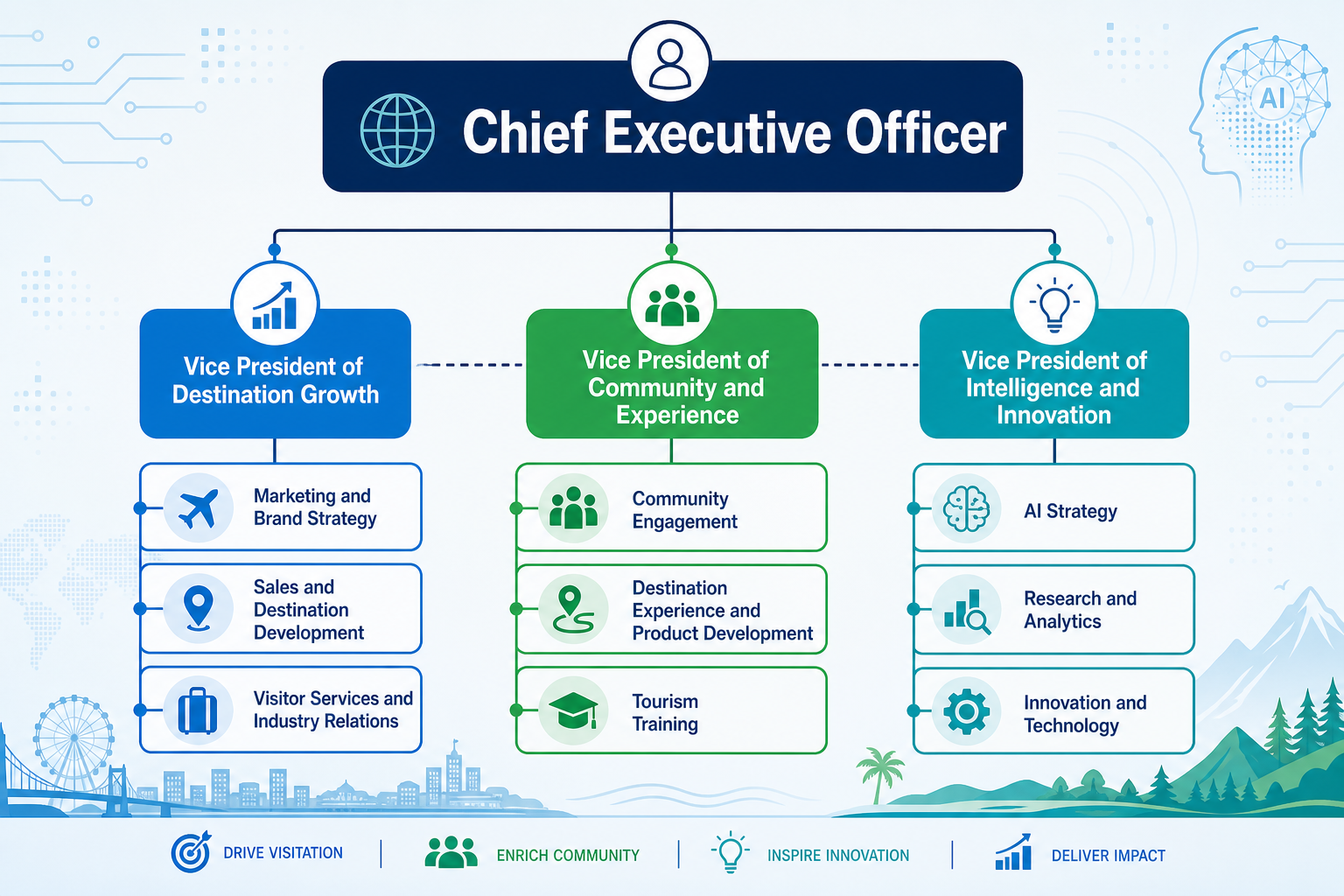
A Possible Destination Organization Org Chart for 2030
Imagine a destination organization structured like this:
President/Chief Executive Officer/Executive Director
Vice President of Destination Growth
- Sales
- Meetings and Events
- Partnership Development
- Industry Relations
Vice President of Community and Experience
- Visitor Experience
- Accessibility
- Community Champions
- Resident Engagement
- Stewardship Programs
Vice President of Intelligence and Innovation
- AI Strategy
- Destination Intelligence
- Research and Analytics
- Knowledge Management
Vice President of Brand and Content Systems
- Marketing
- Communications
- Content Operations
- SEO and AEO
- Digital Experience
Director of Learning and Workforce Development
- Tourism Training
- Professional Development
- Tourism Ambassador Programs
- Industry Education
- Leadership Development
Notice the difference. Learning, intelligence, and community engagement move closer to the center of the organization. These functions become strategic drivers rather than supporting activities.
The Most Valuable Skill in the Age of AI
Many people assume that prompting AI will become the most valuable professional skill.
It may not even make the top five.
The destinations that thrive will employ people who can:
- Learn continuously
- Adapt quickly
- Think critically
- Communicate clearly
- Build trust
- Demonstrate empathy
- Connect people and ideas
Technology can generate answers. People create meaning.
Tourism has always been a people-centered industry, and that reality is unlikely to change.
If anything, AI may make human skills more valuable than ever.
Final Thoughts
Artificial intelligence is not simply changing how destination organizations market themselves. It's changing how they operate, collaborate, learn, and lead.
The future destination organization will likely be less focused on producing information and more focused on curating knowledge, building relationships, and creating meaningful connections between people and places.
The organizations that succeed will not necessarily be those with the most advanced AI systems. They will be the ones who combine technology with curiosity, empathy, learning, and community engagement. Those capabilities have always been the foundation of great destinations. AI is simply making them more important.
About the Author - Sarah Benoit
Sarah Benoit is a marketing strategist, technology expert, and adult educator passionate about helping destinations, nonprofits, tourism businesses, and purpose-driven brands connect with their audiences through authentic storytelling and innovative digital marketing. Since 2003, Sarah has spent more than two decades helping organizations navigate emerging technologies, build meaningful relationships online, and develop sustainable marketing strategies that drive measurable results. As Lead instructor at Learn Tourism, she is a sought-after speaker and trainer specializing in digital marketing, AI, social media, community engagement, and leadership. She empowers professionals to embrace change and lead with curiosity, creativity, emotional intelligence, and confidence. Through her work, Sarah champions lifelong learning and believes that technology is most powerful when it strengthens human connection.
About Learn Tourism the nonprofit academy...
Learn Tourism is a 501c3 nonprofit organization dedicated to advancing the tourism industry through innovative educational practices and professional development initiatives. Our mission is to harness the power of science, business psychology, and adult education to build sustainable economies and enrich the tourism landscape.