
AI Didn’t Break Destination Marketing. It Revealed What Matters Most.
AI Didn’t Break Destination Marketing. It Revealed What Matters Most.
Artificial intelligence is changing tourism marketing faster than any technology in recent memory—but not in the way most destination leaders think.
The real disruption isn’t content creation. It’s control.
For decades, destination marketing organizations (DMOs) positioned themselves as the primary source of truth. Travelers visited websites, read curated blogs, and followed carefully crafted campaigns. Today, that model is dissolving. Travelers are increasingly turning to AI tools to plan their trips—often bypassing destination websites entirely.
This shift introduces a fundamental question:
If travelers aren’t coming to you… how do you still shape their experience?
The answer isn’t louder marketing. It’s smarter strategy—and more human connection.
The Discoverability Problem Is Real (and Growing)
AI has fundamentally changed how travelers discover destinations. Instead of searching websites, they’re asking questions and receiving synthesized answers from large language models.
That means your destination’s voice is now competing inside systems you don’t control.
Website traffic? It’s no longer the north star.
Many destination leaders are already seeing this shift firsthand, recognizing that traditional web metrics are becoming less reliable indicators of influence.
But here’s the opportunity hiding inside the disruption:
Influence hasn’t disappeared—it’s just moved upstream.
AI as a Strategist, Not a Copywriter
Too many tourism organizations are focused on using AI to generate content faster.
That’s a mistake.
AI’s greatest value isn’t in writing social posts—it’s in shaping better decisions.
When used effectively, AI becomes a form of decision intelligence:
- Forecasting traveler behavior
- Identifying emerging markets
- Optimizing campaigns in real time
- Understanding visitor expectations at scale
This shift reframes AI from a marketing tool to a leadership tool.
As shared in the interview, “AI shouldn’t make your marketing louder—it should make it smarter.”
And when it does, the impact extends far beyond marketing.
The Hidden Advantage: Strengthening the Entire Visitor Economy
The most forward-thinking destinations are using AI insights to elevate their entire ecosystem—not just their campaigns.
That includes:
- Sharing insights with local businesses
- Improving workforce readiness
- Aligning messaging across stakeholders
- Training front-line workers to meet evolving expectations
This is where tourism training becomes a competitive advantage.
Because no matter how advanced AI becomes, it still can’t replace the moment that defines a visitor’s experience:
A human recommendation.
From Information to Storytelling: The Frontline Transformation
A traveler doesn’t remember a list of attractions.
They remember a story.
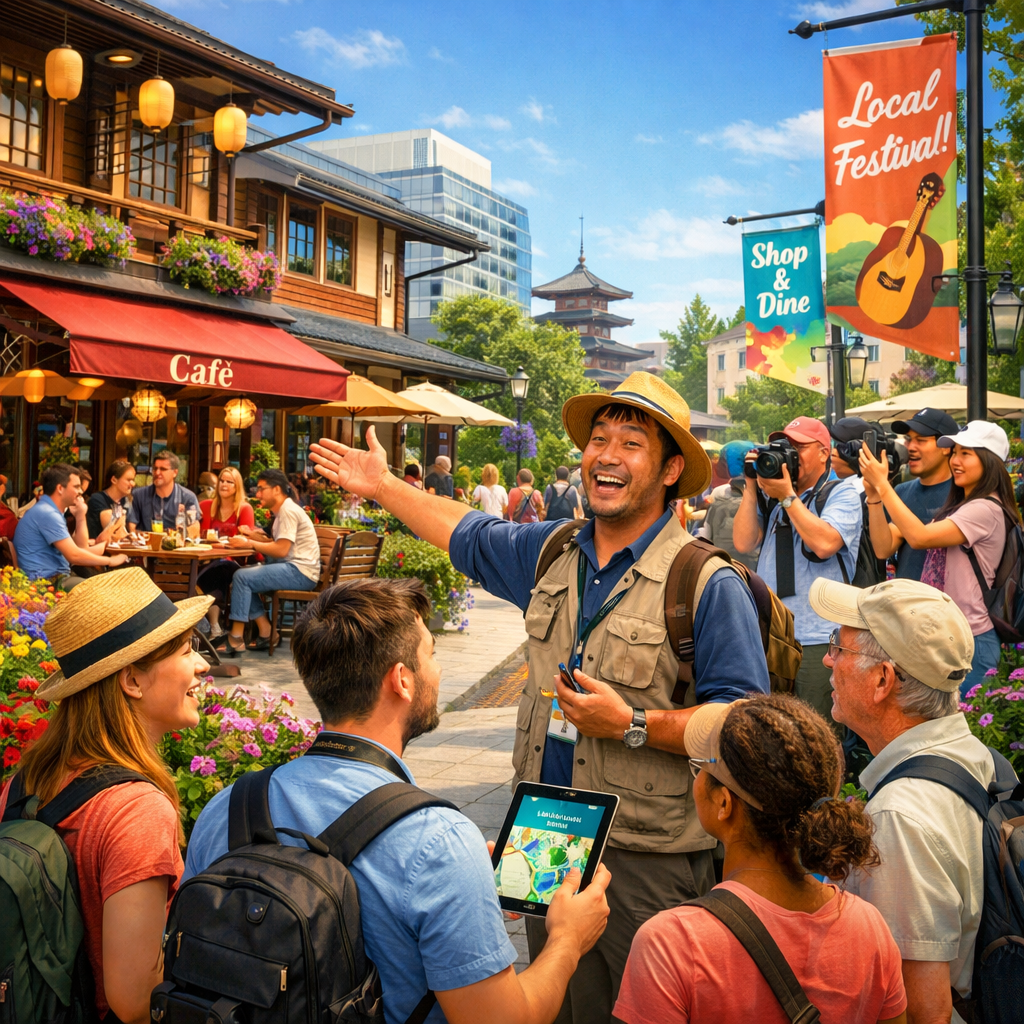
One of the most overlooked opportunities in tourism marketing is empowering frontline workers to move beyond information-sharing into storytelling.
Instead of:
“There’s a restaurant around the corner.”
It becomes:
“There’s a place around the corner where I take my mom for special occasions—I think you’ll love it.”
That’s not marketing. That’s meaning.
And that transformation doesn’t happen by accident—it happens through intentional tourism training designed for behavior change, not memorization.
Check Out: Tourism Ambassador Training
The Real Risk of AI: Losing Authenticity
AI introduces power—but also risk.
Without clear leadership and policy, destinations face:
- Brand inconsistency
- Misinformation
- Ethical concerns
- Loss of authentic voice
And perhaps most importantly:
A disconnect from the community they represent.
AI is not an IT issue. It’s a leadership responsibility.
The destinations that will win in this next era are the ones that establish:
- Clear guidelines for AI use
- Human oversight in content and recommendations
- Defined data and privacy boundaries
Because trust—not technology—will determine long-term success.
Community Is the New Distribution Channel
Here’s the paradox:
As technology becomes more powerful, human connection becomes more valuable.
The destinations thriving today aren’t just investing in digital tools—they’re investing in their communities.
They are:
- Building stronger relationships with local businesses
- Empowering residents as storytellers
- Aligning tourism with community well-being
- Reinforcing tourism’s value beyond “heads in beds”
Because when a community believes in tourism, it becomes your most powerful marketing engine.
And unlike algorithms, communities don’t change overnight.
Three Practical Ways to Stay Human in an AI-Driven World
- Put real people at the center of your story
Highlight business owners, residents, and frontline workers. Authentic voices outperform polished messaging every time. - Turn partners into storytellers
Your restaurants, attractions, and guides are your best content creators. Equip them to share experiences, not just promotions. - Train for stewardship, not just service
When communities understand why tourism matters, they naturally deliver better visitor experiences.
The Future of Tourism Isn’t Artificial. It’s Amplified.
AI will continue to reshape how travelers discover and experience destinations.
But it won’t replace what makes travel meaningful.
It won’t:
- Make a bed in a hotel
- Serve a meal with care
- Listen and respond with empathy
- Share a story that connects
That’s still human.
And it always will be.
The destinations that succeed won’t be the ones that use AI the most.
They’ll be the ones that use it best—to amplify humanity, not replace it.
Why This Matters for Tourism Training
This moment is redefining what effective tourism training looks like.
It’s no longer about:
- Memorizing facts
- Passing tests
- Completing static programs
It’s about:
- Building confidence
- Encouraging curiosity
- Enabling storytelling
- Driving real behavior change
Because in a world where information is everywhere…
The experience is the differentiator.
About Learn Tourism the nonprofit academy...
Learn Tourism is a 501c3 nonprofit organization dedicated to advancing the tourism industry through innovative educational practices and professional development initiatives. Our mission is to harness the power of science, business psychology, and adult education to build sustainable economies and enrich the tourism landscape. Visit us at learntourism.org.