
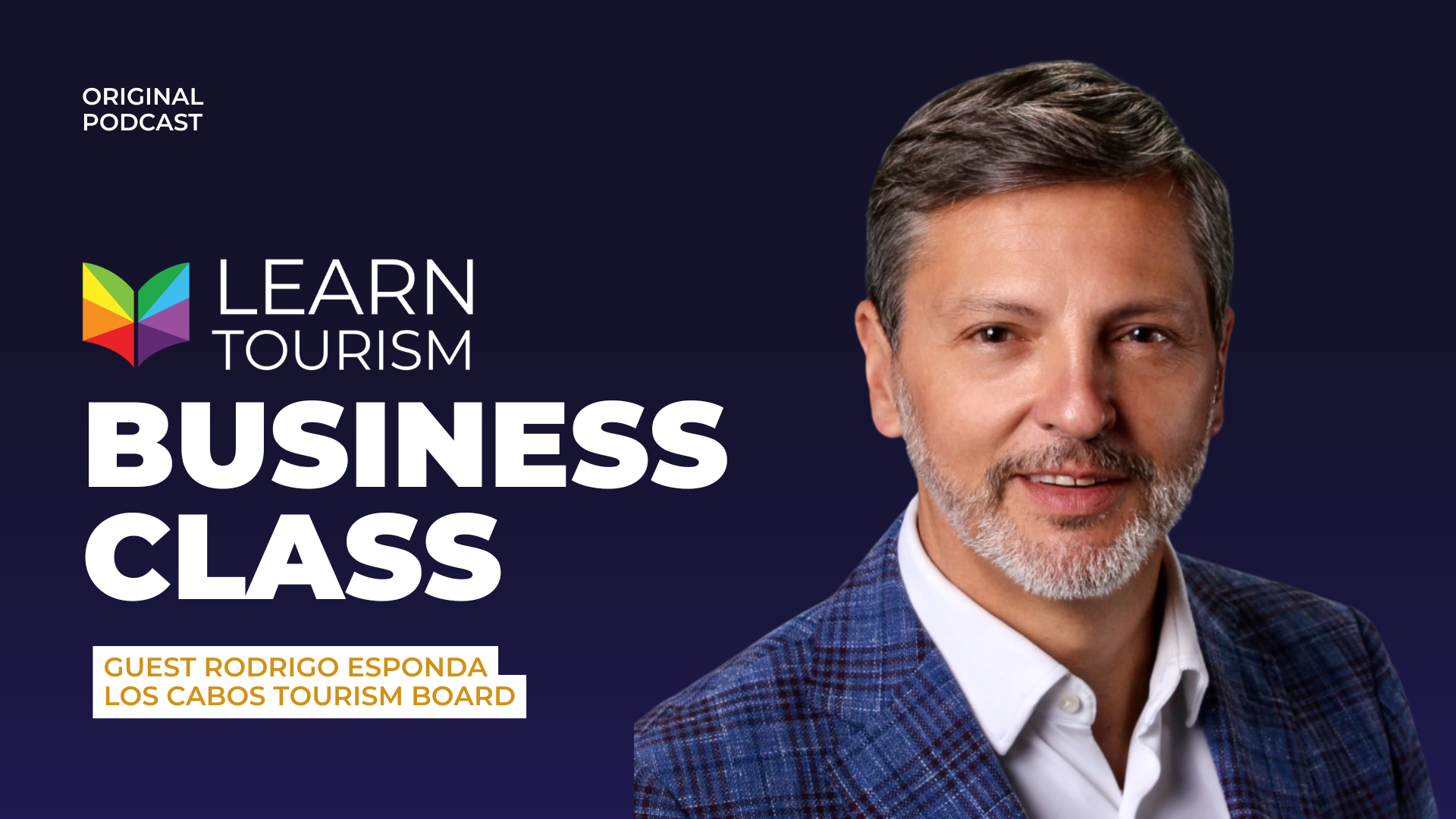
Beyond the Beach: Rodrigo Esponda's Vision for the Future of Los Cabos
The Travelers We Choose: What Los Cabos Teaches Us About the Future of Tourism
Tourism leaders often talk about attracting more visitors.
Rodrigo Esponda wants us to ask a different question:
What kind of visitors are we attracting?
As Managing Director of the Los Cabos Tourism Board, Rodrigo has spent the last decade helping guide one of North America's most successful tourism destinations. During that time, visitor spending has increased, the average length of stay has grown, and the destination has expanded its reputation far beyond luxury resorts and pristine beaches.
But for Rodrigo, success isn't measured solely by occupancy rates or visitor counts.
It's measured by whether tourism improves residents' lives, preserves local culture, protects natural resources, and creates meaningful connections between people.
That perspective was at the heart of our recent conversation on Business Class.
Beyond the Postcard
Many travelers know Los Cabos for its iconic coastline, luxury accommodations, and world-class hospitality.
What many don't realize is that the region is far more diverse than the images used to market it often suggest.
Mountain ranges rise more than 7,000 feet above sea level. Rural communities offer authentic cultural experiences. Birdwatchers, hikers, divers, and outdoor enthusiasts can spend days exploring landscapes that look entirely different from the beaches featured in tourism advertisements.
When Rodrigo arrived a decade ago, he challenged his team to explore parts of their own destination that had received little attention.
The result wasn't simply a new marketing campaign.
It was a broader understanding of what Los Cabos truly is.
By telling a richer story—one that includes the ocean, the desert, the mountains, local communities, and cultural heritage—the destination has attracted visitors seeking more than a resort stay.
That shift offers an important lesson for destinations everywhere.
The strongest destination brands aren't built solely on attractions. They're built on authentic stories.
Tourism's Greatest Resource Is People
Throughout our conversation, Rodrigo repeatedly returned to one theme: people.
He spoke passionately about workforce development, professional training, and creating opportunities for tourism professionals at every level.
In many organizations, workforce development falls outside the traditional responsibilities of a destination marketing organization. Yet Rodrigo sees talent development as essential to long-term success.
Why?
Because every interaction shapes the visitor experience.
The person greeting travelers at the airport.
The concierge is offering recommendations.
The server describes a local dish.
The tour guide shares stories about a community.
Each becomes part of the destination's story.
As Rodrigo explained, a tourism board isn't just the people whose names appear on the organizational chart.
Everyone who interacts with visitors becomes an ambassador for the destination.
That reality makes education, training, and professional development more important than ever.
A Different Definition of Sustainability
The tourism industry often talks about sustainability in environmental terms.
Protecting wildlife.
Reducing waste.
Preserving natural resources.
Those efforts matter. But Rodrigo argues that true sustainability requires a broader perspective.
Environmental sustainability must be accompanied by social and cultural sustainability.
Communities should benefit from tourism.
Residents should experience improved quality of life.
Local traditions should be celebrated and preserved rather than diluted.
Future generations should inherit destinations that are stronger than the ones we enjoy today.
One of the most compelling examples Rodrigo shared came from Cabo Pulmo, a small community along the Sea of Cortez.
Thirty years ago, local fishing families recognized that declining fish populations threatened their future. Instead of continuing down an unsustainable path, they chose a different approach. They protected the reef, embraced ecotourism, and became stewards of the natural resources that surrounded them.
Today, the community has improved its quality of life while protecting one of the world's most remarkable marine ecosystems.
It's a powerful reminder that tourism can be a force for conservation when communities are empowered to lead.
Quality Over Quantity
For decades, many destinations pursued a simple goal: attract more visitors.
More arrivals.
More room nights.
More volume.
Rodrigo believes the future requires a different approach.
Rather than focusing exclusively on visitor numbers, destinations should aim to attract travelers who are curious, respectful, and engaged.
Visitors who want to learn.
Visitors who appreciate local culture.
Visitors who support local businesses.
Visitors who understand the importance of preserving the places they enjoy.
These travelers often stay longer, spend more, and create stronger connections with the communities they visit.
More importantly, they contribute to a tourism economy that benefits everyone involved.
The objective isn't exclusivity.
It's intentionality.
The Human Connection
Perhaps the most memorable part of our conversation came when Rodrigo reflected on why he loves tourism after more than three decades in the industry.
His answer had little to do with hotels, flights, or marketing campaigns.
It was about human connection.
Tourism creates opportunities for people from different backgrounds, cultures, and experiences to learn from one another.
It allows us to discover new places.
To challenge assumptions.
To develop empathy.
To better understand our shared humanity.
In an increasingly connected yet often divided world, that may be tourism's greatest contribution.
Not simply economic development.
Not visitor spending.
Not even destination promotion.
Human connection.
What Tourism Leaders Can Learn
Rodrigo's leadership offers an important reminder for all of us working in tourism.
Destinations are more than products.
Visitors are more than customers.
Communities are more than stakeholders.
Tourism succeeds when it creates value for everyone involved.
The destinations that thrive over the next decade will be those that invest in their people, tell authentic stories, protect what makes them unique, and intentionally attract travelers who share those values.
That's not just a strategy for tourism growth.
It's a strategy for building better places.
And that's a future worth traveling toward.