
Can People Actually Learn From It? A 5-Question Accessibility Test for Training
Accessibility isn't a checklist. It's a design question.
When most tourism and hospitality organizations hear "accessibility," they think physical: ramps, elevators, accessible restrooms. Important, yes — but it's only part of the picture. In our recent webinar with Alvaro Silberstein, CEO and co-founder of Wheel the World, and Learn Tourism's Steve Ekstrom, we dug into a bigger question: what does accessibility actually mean when the thing you're building is a learning experience?
Every destination is in the business of learning. Staff, volunteers, community members, and visitors are all learners at some point, and if your training only works for people who already have the "right" starting point — the right device, the right reading level, the right amount of free time, the right physical ability — you're not really training everyone. You're training whoever happens to fit the mold you built.
Three pillars, one starting point
Alvaro walked us through how Wheel the World thinks about accessible travel in three pillars: infrastructure (can a traveler physically get there and move through it?), information (can they find out, ahead of time, whether a place will work for them?), and people (are the humans they'll interact with along the way prepared to help well?).
That third pillar — people — is where training comes in. You can build a ramp, but if the front-desk employee doesn't know how to welcome a guest who uses a wheelchair, or a tour guide hasn't thought through how to describe a scenic overlook to a guest who is blind, the experience still falls short. Infrastructure and information only pay off when the people pillar is trained well.
Five barriers we build without meaning to
On the instructional design side, Steve laid out five barriers that quietly creep into training content, even when the intent is good:
Access — can the learner even get to the material, on their device, with their connection, without a login wall in the way? Language — is it written for an expert, or for a busy frontline employee learning something new? Format — does it lean on one format (text-heavy slides, long unbroken video) when your audience needs multiple ways in? Cognitive load — are you asking someone to hold ten new ideas in their head at once? Transfer — does the training actually change what someone does differently on their next shift, or does it stay theoretical?
None of these show up as an obvious "error." They show up as lower completion rates, staff who technically finished the training but can't apply it, and community members who never engaged with a program that was supposedly built for them.
Design for the edges, not the middle
The reframe Steve offered is a simple one: design for the edges of your audience, not the average. If your training works for someone with a slow connection, limited English proficiency, or a learning difference, it will work for everyone else too. Design for the "typical" learner and you'll quietly exclude a chunk of the very people you're trying to reach — while never knowing exactly who or how many.
The five-question test
Before launching any learning experience — a workshop, an onboarding module, a keynote, a customer-service training — run it through five questions:
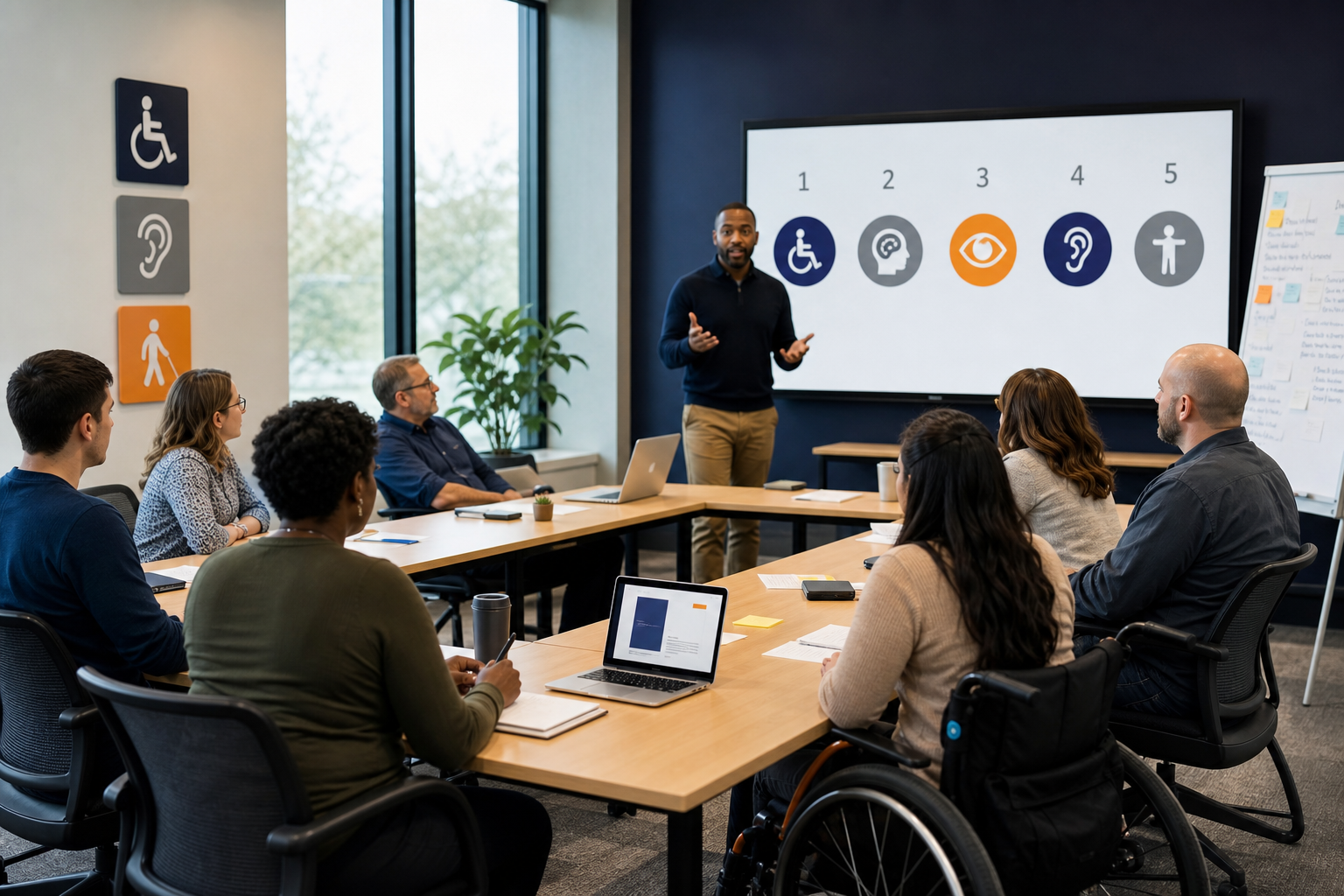
Can people get to it? (technology, device, navigation, physical and digital access) Can people understand it? (language, structure, readability, cognitive load) Can people engage with it? (captions, formats, pacing, interaction, choice) Can people remember it? (reinforcement, relevance, examples, practice) Can people use it? (does the learning actually translate into behavior on the job?)
If you can't confidently answer "yes" to all five, that's not a failure — it's useful information about exactly where to revise before you launch.
Try it this week
Pick one piece of training your organization already uses — an onboarding video, a seasonal staff refresher, a volunteer orientation — and run it through the five questions above. You don't need a redesign to start; you need one honest pass and a short list of what to fix first.
Want the full conversation, including Alvaro and Steve's live Q&A with attendees? Watch the webinar recording here. To learn more about Wheel the World's work in accessible travel, visit wheeltheworld.com. And if your team is ready to build training that clears all five questions, that's exactly the kind of learning experience we help destinations design at Learn Tourism.