
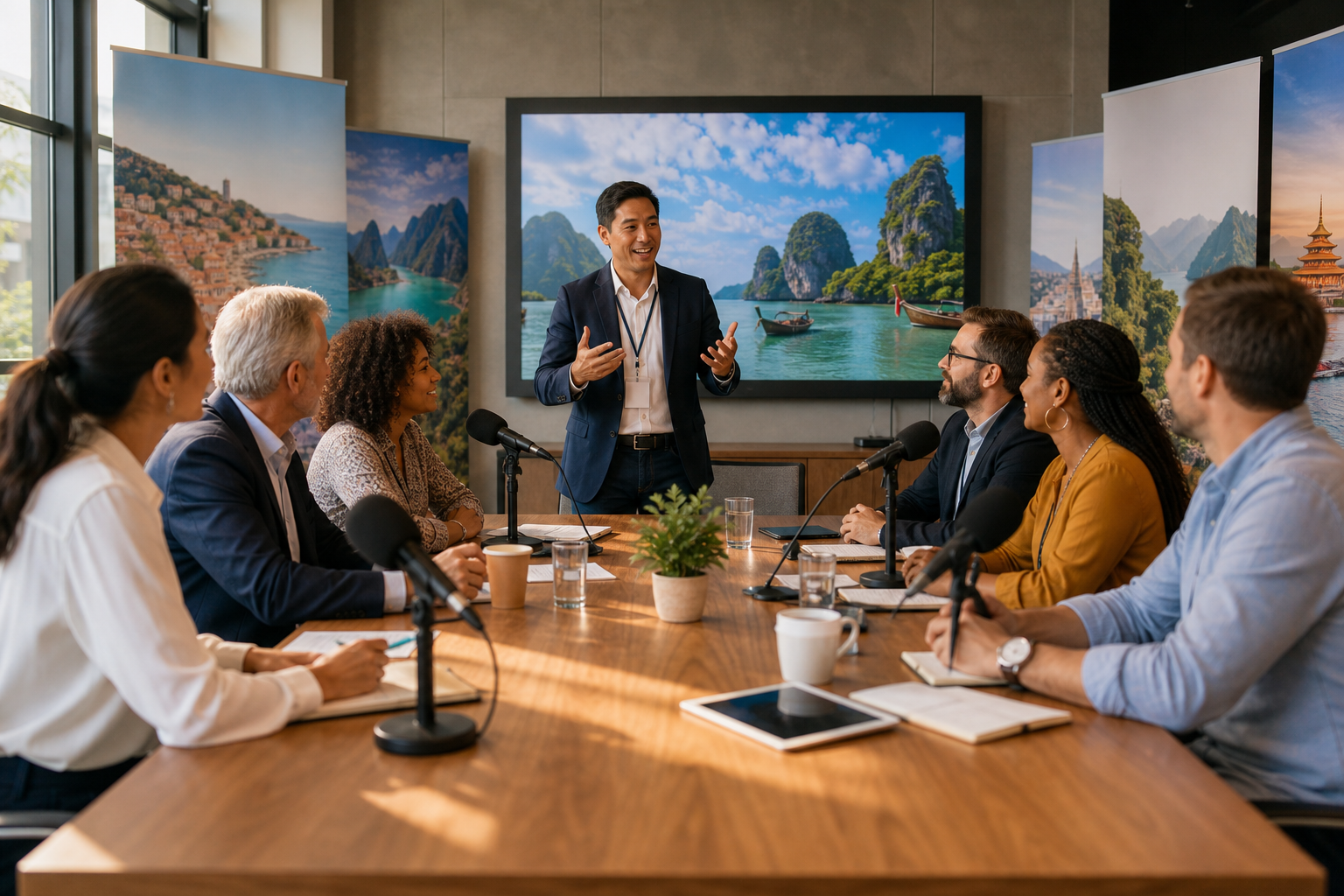
200+ Executive Conversations: What Tourism's Best Leaders Have Taught Me
What 200+ Tourism Leaders Taught Me About Leadership, Learning, and the Future of Travel
Over the past several years, I’ve had the privilege of sitting down with more than 200+ tourism leaders, destination executives, association CEOs, entrepreneurs, educators, and changemakers on the Learn Tourism Business Class podcast. What began as a simple curiosity about leadership and learning has become one of the most rewarding educational experiences of my career.
People often ask what I've learned from these conversations.
The answer is both simple and surprisingly consistent: despite representing different destinations, organizations, cultures, and career paths, the most successful leaders in tourism share remarkably similar perspectives on people, purpose, and progress.
Here are some of the most important lessons I've gathered from 200+ conversations.
Tourism Is Ultimately a People Business
The most accomplished leaders rarely talk first about visitor numbers, hotel occupancy, tax revenue, or marketing campaigns.
They talk about people.
They talk about residents. Team members. Partners. Business owners. Community leaders. Visitors. Students. Mentors.
Again and again, I've heard that sustainable success in tourism comes from building relationships and earning trust.
The destinations making the greatest strides aren't necessarily those with the biggest budgets. They're often the ones where stakeholders collaborate effectively, communicate openly, and work toward shared goals.
Tourism succeeds when people succeed.
Great Leaders Remain Curious
One of the most surprising discoveries is how little the best leaders pretend to know.
The most respected CEOs and executives I've interviewed consistently ask questions. They seek new perspectives. They challenge their assumptions.
Many openly admit they are still learning.
Whether discussing artificial intelligence, destination stewardship, workforce development, accessibility, sustainability, or community engagement, the strongest leaders approach change with curiosity rather than certainty.
They understand that expertise isn't the absence of learning.
It's the commitment to never stop learning.
Community Comes Before Promotion
A recurring theme across hundreds of conversations is that destinations cannot market their way out of community problems.
When communities struggle with housing, workforce shortages, infrastructure challenges, environmental concerns, or resident sentiment, successful leaders don't ignore those realities.
They address them.
The most admired destination organizations increasingly view themselves as community development organizations rather than marketing organizations.
Their focus extends beyond attracting visitors. They work to improve quality of life, strengthen local businesses, preserve culture, and create long-term value for residents.
When communities thrive, tourism follows.
The Future Belongs to Collaborators
If there is one leadership trait that consistently predicts success, it may be collaboration.
The tourism industry is uniquely interconnected. Hotels depend on attractions. Attractions depend on transportation. Restaurants depend on events. Events depend on destinations. Destinations depend on communities.
No organization succeeds alone.
Many of the leaders I've interviewed have become masters of bringing people together who may not naturally sit at the same table. They build coalitions, facilitate conversations, and help diverse groups find common ground.
The future of tourism won't be built by individual organizations competing for attention.
It will be built by partnerships working toward common outcomes.
Career Paths Are Rarely Linear
One of my favorite discoveries has been how unpredictable tourism careers often are.
Many leaders never intended to work in tourism.
I've spoken with former teachers, journalists, musicians, lawyers, marketers, hospitality workers, economic developers, event planners, and entrepreneurs who unexpectedly found themselves in tourism leadership roles.
Few followed a straight path.
Instead, they followed opportunities, relationships, interests, and a willingness to say "yes" to new experiences.
For students and emerging professionals, this lesson is especially important: your career doesn't need to follow a predetermined roadmap.
It simply needs forward momentum.
Adaptability Is More Valuable Than Expertise
The tourism industry has faced enormous disruption over the past decade.
Pandemics. Economic uncertainty. Political shifts. Technological transformation. Workforce shortages. Changing traveler expectations.
Through every challenge, one characteristic consistently separates resilient leaders from struggling ones: adaptability.
The leaders who thrive are not necessarily those with the most experience.
They're the ones willing to evolve.
They experiment. They learn from failure. They adjust quickly when circumstances change.
In a world where change is constant, adaptability may be the most important professional skill any of us can develop.
Purpose Outlasts Strategy
I've interviewed leaders from destinations large and small, urban and rural, domestic and international.
While their strategies differ, the most effective leaders share a strong sense of purpose.
They know why their work matters.
Some are driven by economic development. Others by community pride, cultural preservation, environmental stewardship, workforce development, or creating opportunities for future generations.
Purpose provides clarity during uncertainty.
When circumstances change—as they inevitably do—purpose becomes the anchor that guides decision-making.
Workforce Development Is Everyone's Responsibility
A topic that appears in conversation after conversation is the challenge of attracting, developing, and retaining talent.
Many leaders worry about succession planning, leadership pipelines, and workforce shortages.
Yet the most forward-thinking organizations aren't waiting for someone else to solve the problem.
They're investing in mentorship.
They're creating opportunities for young professionals.
They're partnering with schools, colleges, and industry associations.
They're building cultures that encourage continuous learning.
The future of tourism depends on developing future leaders today—a principle that inspired Learn Tourism's workforce development podcast initiative and broader educational mission.
Optimism Is a Leadership Skill
Perhaps my biggest takeaway from 200+ episodes is that optimism is not naïveté.
The leaders I admire most fully understand the challenges facing tourism.
They know the obstacles.
They see the risks.
But they also see possibilities.
They believe communities can improve.
They believe people can grow.
They believe tourism can be a force for good.
That optimism isn't accidental. It's a deliberate choice that influences how they lead, communicate, and inspire others.
The Most Important Lesson
After 200+ conversations, one lesson stands above the rest.
Leadership is less about having answers and more about helping others discover what's possible.
The tourism leaders who leave lasting legacies aren't remembered for launching the biggest campaigns or managing the largest budgets.
They're remembered because they invested in people.
They created opportunities.
They built trust.
They inspired others to believe in themselves and their communities.
And in an industry built on creating memorable experiences for others, that may be the most meaningful contribution of all.
Every conversation reinforces why learning matters. The tourism industry changes constantly, but the desire to grow, connect, and contribute remains universal. After 200-plus episodes, I'm more convinced than ever that our industry's greatest asset isn't a destination, attraction, or marketing campaign.
It's the people who choose every day to make tourism better for everyone.