
What Tofino Teaches About Stewardship, Respect, and Choosing a Place
A Business Class conversation with Samantha Hackett, Executive Director of Tourism Tofino
Picture a town of 2,500 people on the far western edge of Canada. Now add just over 700,000 visitors a year. That is Tofino, British Columbia, where Samantha Hackett has called home for almost 20 years.
Samantha stepped into the executive director role at Tourism Tofino in December, after nearly two decades working in the town's hospitality industry, starting at Long Beach Lodge Resort at age 20. She knows the place from the front desk and from the boardroom. In this episode of Business Class, she talks about what it takes to balance a tiny resident population against a huge visitor one, why a First Nations teaching of respect now sits at the center of Tofino's destination stewardship plan, and what a day of clam gardening taught her about how much a destination still has to learn.
A community of people who chose to be there
Most Tofino residents were visitors first. Samantha says very few people were born and raised in town. "[Most] have come here as visitors, have enjoyed an aspect of Tofino that they've seen, and have moved here or moved here for the job, the industry."
That shapes how the community relates to tourism. When your neighbors arrived as travelers themselves, the visitor perspective is not abstract. As Samantha puts it, that dynamic "creates this love and passion that I don't see in every community, that people have really chosen to live here."
Choosing Tofino is not the easy option. It is rural and remote, and the cost of staying is real. "We always talk about it being harder to live here than it is to leave here," she says. "It's hard to stay in our community and make a life here. So the passion that people have for this community, they're staying for a reason."
There is a flip side, though. The kids who were born there did not get to choose, and Samantha has noticed that "some of that passion wears off." One of the quieter wins of bringing residents and surrounding communities together has been watching those young people "start to really see the community in a different light."
Try this: Think about the residents of your own destination. How many arrived as visitors? How many were born there and never chose it? Those two groups probably need very different invitations to see tourism as something that belongs to them. What would each invitation sound like?
Stewardship is a word. Respect is the teaching.
Tofino sits within Tla-o-qui-aht territory, one of several Nuu-chah-nulth nations along that coast. Samantha is candid that when she arrived two decades ago, that fact "wasn't something that was acknowledged or talked about, or we just didn't have the opportunity to learn." She has watched that change and counts herself lucky to be part of it.
Her hope for today's visitor is simple: know where you are. "Just even that simple learned acknowledgment of being able to say, 'I was in Tofino, which is within Tla-o-qui-aht territory. I was within the Tla-o-qui-aht Tribal Park." That small piece of learning, she says, "really acknowledges everything that Tofino is. The rainforest, the water, the animals, the people." And it recognizes something destination leaders often forget to say out loud: "That's why we have visitors. That's why visitors want to come here, it's because of all that stewardship that's happened in this area."
Over the past two years, Tourism Tofino traded the traditional tourism master plan for what they call a destination stewardship plan. The process forced a harder question than "how do we grow": what is our identity as a community and as a destination, and how do those intersect so residents and visitors both feel a connection to place?
At the heart of the plan is a Nuu-chah-nulth teaching that Tla-o-qui-aht shared with the community. Samantha describes it as the teaching of respect, and it reframes what the industry buzzword actually means:
"It is really about respect. And so we know that in the English language as stewardship. That's respecting land and respecting animals, respecting each other, and then taking that respect that you have and then doing something about it and trying to be better and leave things better than you found it."
She points out that this teaching predates the tourism industry by generations. "That is why there are still old-growth trees, and there are still salmon in the water, because that was the teaching." Tla-o-qui-aht now invites visitors, residents, and businesses alike to take a pledge built on it, and Tourism Tofino has become one of the mechanisms for helping people find it.
Why does that matter beyond Tofino? Because Samantha believes travelers want a way in. "If you travel at all, you want to connect to those places that you're visiting." A pledge gives well-meaning people something concrete to do with their good intentions.
Try this: Read your destination's stewardship or master plan and count how many times it asks visitors to do something specific versus how many times it describes what the destination is. If the second number dwarfs the first, you have a description, not a teaching. What is one clear, respectful action you could invite people to take?
Forget the manager meeting. Go clam gardening.
Asked what she wants to learn in the coming year, Samantha did not name a software platform or a marketing tactic. She named clams.
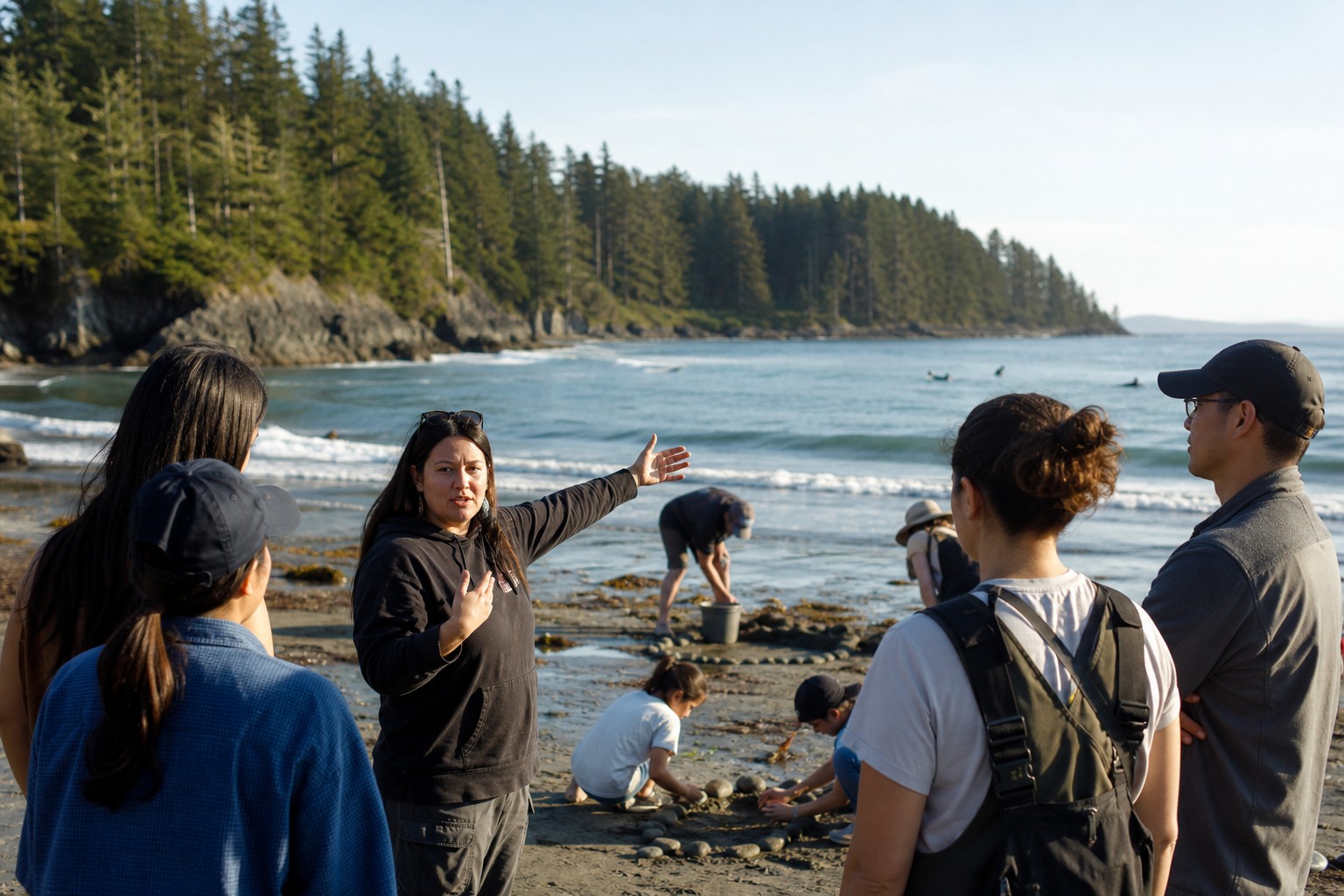
Tla-o-qui-aht recently invited Tourism Tofino to join a day of clam gardening, the practice of building and maintaining rock-walled beach habitats that First Nations communities along the coast have stewarded for generations. Samantha had lived in Tofino for two decades and eaten plenty of seafood. But the life cycle of the clams she had walked past on the beach a thousand times? "I've never learned, and there has not been any opportunity to learn."
The invitation landed on the same day as a scheduled manager meeting. Her call: "Forget the manager meeting. Why don't we invite all the managers to go clam gardening?"
What came out of one day on the beach was more than a memorable team outing. It opened a conversation about the gardens themselves, many of which have deteriorated in recent years, and about how Tourism Tofino might help Tla-o-qui-aht rebuild and maintain them. "It's all part of our ecosystem, one of the many pieces to make it all function."
Samantha's larger point is about humility. "Through our relationships with Tla-o-qui-aht, that's where there's so much learning that we just haven't uncovered, and we haven't taken the time and taken the space to listen and learn those teachings."
Stephen connected it to a conversation he'd had the day before: there is only so much knowledge in any one room. Growth happens when we open our eyes and ears to what sits outside our definition of our job or our company. Something learned on a beach or on a walk through the woods can make us better at our work on Monday.
Try this: When was the last time your team learned something together that had nothing to do with a screen? Look at your next month of standing meetings and ask which one could become a field trip led by someone in your community who knows something you do not.
More depth than the postcard
Tofino calls itself the surf capital of Canada, home to the country's first Olympic surfer. But when Stephen asked what she wishes more people knew, Samantha's answer was simply "that there is so much depth," and much of that depth is cultural.
Visitors, she says, "wanted to connect with some sort of history." Unlike a city with a major museum or cultural center, Tofino does not have a single place where you can "just go somewhere and learn everything." So the recurring visitor question was: how do I connect? How do I learn something? Answering it is now part of the destination's work. She points to Naa'Waya'Sum Gardens, a garden space now owned and operated by Tla-o-qui-aht members, where "visitors are really looking for a space to go to learn on their own terms." Next on her list: helping bring back traditional dugout canoe tours led by Tla-o-qui-aht members, and something as basic as signage that names places in the Nuu-chah-nulth language.
And then there is the thing that is hardest to put on a website. Samantha once assumed she would never raise children in a town two hours from an arena, a pool, or a riding stable. She now has a six-year-old and a nine-year-old, and years of leading Girl Guides showed her a different kind of childhood: kids who play in the street until 10 o'clock on summer nights, knock on neighbors' doors, and treat camping like nothing. "Every year, every experience that I have in Tofino, I learn something new about the reason why I love it."
She thinks visitors feel something similar. "When they come here, they're going to get a different experience every single time, and they connect more and more. And not everybody's sure why."
A question to sit with
Samantha's story threads together a few ideas that Learn Tourism cares deeply about: destination stewardship rooted in relationships rather than slogans, community engagement that includes the people who never chose the place, and the kind of continuous learning that requires leaders to admit what they do not know.
So here is the reflection prompt to carry with you. Samantha said Tofino has visitors because of generations of stewardship that happened long before tourism arrived. Whose care made your destination worth visiting? Do they have a voice in how it is shared today? And what would it look like to say thank you not just with a land acknowledgment, but with a day of work alongside them?
Plan a visit at tourismtofino.com, and if you go, learn whose territory you are standing in.
Business Class is a podcast by Learn Tourism, featuring conversations with destination and tourism leaders from around the industry. Learn more at learntourism.org.