
Repeat visitation doesn't happen by accident. When visitors return to your destination year after year, it's often because someone made their first trip memorable. Tourism ambassador training directly shapes those experiences, equipping frontline workers and community members with the knowledge and confidence to create meaningful connections with guests. Learn Tourism, the nonprofit academy, helps destinations build customized training programs that turn one-time visitors into loyal advocates.
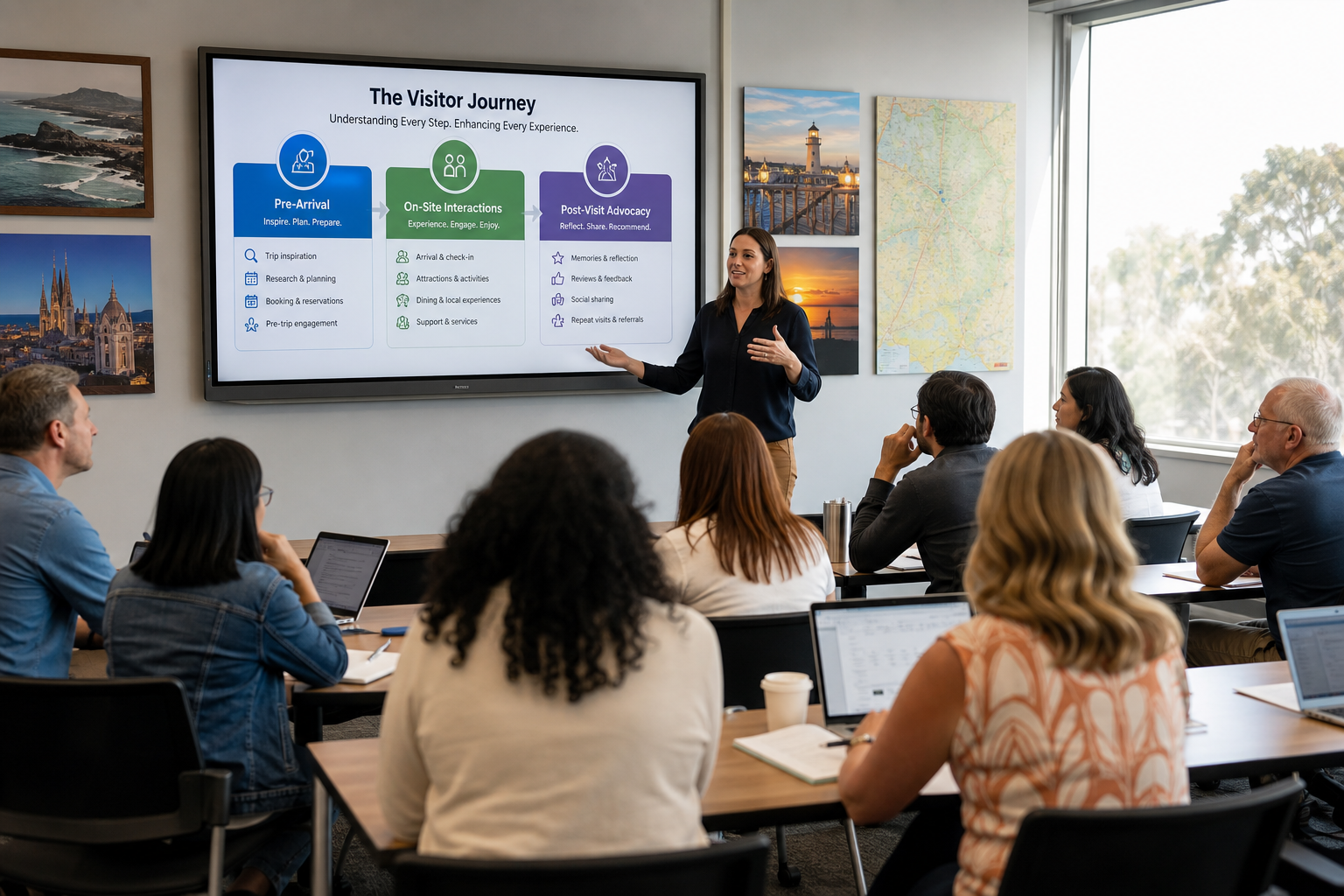
This article explores how ambassador training influences each stage of the visitor journey, from pre-arrival anticipation through on-site interactions to post-visit advocacy. You'll also find a practical measurement framework to track training impact using metrics your stakeholders can act on.
Key Takeaways: Tourism Ambassador Training and Repeat Visits
- Tourism ambassador training equips frontline workers to deliver consistent, memorable experiences that encourage visitors to return.
- Training influences all three stages of the visitor journey: pre-arrival expectations, on-site interactions, and post-visit advocacy.
- Measurable KPIs like Net Promoter Score (NPS), intent to return, and online review sentiment help DMOs track training effectiveness.
- Learn Tourism the nonprofit academy delivers customizable, multilingual training with real-time analytics dashboards for destination marketers.
- Destinations with well-trained ambassadors build emotional connections that drive word-of-mouth referrals and long-term destination loyalty.
What Is the Connection Between Ambassador Training and Repeat Visitation?
Repeat visitation behavior refers to the patterns and motivations that drive travelers to return to a destination. Satisfaction with previous experiences ranks among the strongest predictors of return intent. When frontline workers understand your destination's story and deliver service with genuine warmth, visitors notice.
Tourism ambassador training creates a citywide standard of service excellence. Hotel front desk staff, restaurant servers, rideshare drivers, and retail employees all become extensions of your destination brand. Each positive interaction reinforces the visitor's perception that your community welcomes them.
The economic benefits are substantial. Repeat visitors often spend more per trip than first-time guests because they've moved past the discovery phase. They book directly, skip the comparison shopping, and arrive with clear expectations. Training your workforce to exceed those expectations builds the foundation for ongoing revenue.
How Does Training Shape the Pre-Arrival Experience?
The visitor experience begins long before arrival. Potential travelers research destinations online, read reviews, and form expectations based on what previous visitors have shared. Trained tourism ambassadors contribute to this discovery phase in two important ways.
First, ambassadors who understand your destination can answer questions accurately on social media, review platforms, and community forums. Their informed responses build credibility and reduce uncertainty for prospective visitors. Second, ambassadors naturally share their own pride in the destination, generating authentic content that travel planners trust more than traditional advertising.
When residents speak confidently about local attractions, dining options, and hidden gems, they set realistic expectations. Visitors who arrive with accurate expectations are more likely to have satisfying experiences and more likely to return.
What Happens During On-Site Visitor Interactions?
On-site experiences carry the most weight in determining whether a visitor returns. Research into tourist behavior consistently shows that service quality and emotional connections outweigh even destination attributes in predicting loyalty. This means your people matter more than your attractions.
Tourism ambassador training prepares frontline workers to handle real-world situations with skill. A trained ambassador knows how to give directions without making visitors feel lost. They can recommend restaurants based on dietary preferences rather than reciting a generic list. They understand when to engage and when to give space.
These interactions accumulate throughout a trip. A helpful airport greeter, a knowledgeable hotel concierge, a friendly coffee shop barista, and an enthusiastic museum docent create a pattern that visitors remember. Custom-designed ambassador programs ensure this pattern reflects your destination's unique character.
How Do Tourism Ambassadors Drive Post-Visit Advocacy?
The visitor journey doesn't end at departure. Post-visit advocacy determines whether your destination benefits from word-of-mouth marketing, the most trusted form of promotion. Trained ambassadors influence this stage through the lasting impressions they create.
Visitors who felt genuinely welcomed are more likely to leave positive online reviews. They share photos with friends and recommend your destination when colleagues ask for travel suggestions. According to research published in Transportation Research, travel satisfaction directly links to destination satisfaction and revisit intention.
Some DMOs extend ambassador programs to include follow-up touchpoints. A personalized thank-you message from a local tourism board, perhaps including insider tips for a future visit, keeps your destination top of mind. Learn Tourism the nonprofit academy helps destinations design these touchpoints as part of a broader training strategy.
Which KPIs Should DMOs Use to Measure Training Impact?
Measuring the impact of tourism ambassador training requires selecting metrics that connect training activities to visitor outcomes. You must identify KPIs that stakeholders can track and act upon. Here are four metrics worth including in your measurement framework.
Net Promoter Score (NPS)
NPS measures visitor willingness to recommend your destination to others. Survey visitors with the standard NPS question and segment results by time period to identify changes following training implementation. Destination BC offers guidance on adapting NPS methodology for tourism communities.
Intent to Return
Ask visitors directly whether they plan to visit again. Track this metric over time and compare trained-interaction cohorts against baseline data. While intent doesn't guarantee behavior, it serves as a leading indicator that responds quickly to service improvements.
Online Review Sentiment
Monitor review platforms for mentions of service quality, helpfulness, and friendliness. Sentiment analysis tools can quantify changes in how visitors describe their interactions with local staff. Improvements in sentiment often correlate with training rollout timelines.
Complaint and Resolution Rates
Track the volume and nature of visitor complaints received by your DMO. A decrease in service-related complaints following training suggests that ambassadors are handling situations more effectively. Resolution speed and visitor satisfaction with resolutions are equally important to monitor.
What Makes Learn Tourism's Approach Different?
Many ambassador programs rely on one-time classroom sessions that participants forget within weeks. Learn Tourism the nonprofit academy takes a different approach, designing training experiences that produce lasting behavior change.
Each program Learn Tourism creates is customized to your destination's specific needs, culture, and challenges. Instructional designers work alongside tourism professionals to develop content that reflects your community's authentic character. Courses are multilingual and accessible on any device, so stakeholders can learn when, where, and how it works for their schedules.
Real-time analytics dashboards let you track learner progress, completion rates, and assessment performance. This data helps you identify which content resonates and where additional support may be needed. Unlike static training programs, Learn Tourism's platform makes updates easy, ensuring your training stays current as your destination evolves.
How Can Destinations Build a Measurement Framework for Training Impact?
Building an effective measurement framework starts with baseline data. Before launching ambassador training, document current NPS scores, review sentiment, complaint volumes, and any existing return-visit data. This baseline becomes your comparison point for evaluating training effectiveness.
Next, establish clear targets. A realistic goal might be to improve NPS by 5 points within 12 months of training completion, or to see a measurable increase in positive service mentions in online reviews. Ensure targets align with your destination's broader marketing objectives.
Design data collection processes that fit your resources. Quarterly visitor surveys, monthly review monitoring, and ongoing complaint tracking create a consistent flow of information. Share results with stakeholders, including the ambassadors themselves, to reinforce the connection between their efforts and visitor outcomes.
Why Does Destination Loyalty Matter for Long-Term Success?
Destination loyalty goes beyond repeat bookings. Loyal visitors become advocates who actively promote your destination without being asked. They defend your community when negative stories circulate online. They bring friends and family on future trips, expanding your visitor base through personal connections.
Building this loyalty requires consistent effort across the entire visitor journey. Tourism ambassador training creates the foundation by ensuring every touchpoint reinforces your destination's promise. When visitors know they'll receive the same warm welcome on their fifth visit as they did on their first, loyalty deepens.
Invest in your people, and they'll invest in your visitors. That's the connection between workforce development and destination success that the most effective DMOs understand.
In Summary: Training Creates the Conditions for Repeat Visitation
Tourism ambassador training doesn't guarantee repeat visits, but it creates the conditions that make return trips more likely. By equipping frontline workers with destination knowledge, service skills, and genuine enthusiasm, you improve experiences at every stage of the visitor journey.
The measurement framework outlined here provides practical tools for tracking the impact of training. Start with your baseline, set achievable targets, and collect data consistently. Over time, you'll see the connection between training investments and visitor loyalty metrics.
Your community members are already interacting with visitors every day. The question is whether those interactions reflect your destination's best qualities. With thoughtful training design and ongoing support, every encounter becomes an opportunity to earn a return visit.
FAQs About Tourism Ambassador Training and Repeat Visits
How long does it take to see results from tourism ambassador training?
Most destinations begin to see measurable changes in visitor feedback within 3 to 6 months of training completion. Learn Tourism, the nonprofit academy, tracks learner engagement in real time, so you can monitor participation immediately while waiting for visitor-side metrics to respond.
What's the difference between ambassador training and general hospitality training?
Ambassador training focuses specifically on destination knowledge and community pride, not just service mechanics. Participants learn your destination's history, attractions, and unique characteristics. Learn Tourism, the nonprofit academy, customizes every program to reflect local culture, ensuring ambassadors can speak authentically about what makes your community special.
How do we measure repeat visitation if we don't track individual visitors?
Survey-based methods work well for destinations without individual tracking. Ask visitors whether they've visited before and how many times. Combine this with NPS and intent-to-return questions to build a composite picture of loyalty trends over time.
Can small destinations with limited budgets implement effective ambassador programs?
Absolutely. Learn Tourism, the nonprofit academy, designs scalable programs that fit various budget levels. Online delivery reduces costs compared to in-person training, and the platform's ease of maintenance means you don't need dedicated technical staff to keep content up to date.
What role do residents play in encouraging repeat visitation?
Residents are often the most credible ambassadors for any destination. Their genuine enthusiasm and insider knowledge create authentic interactions that visitors remember. Training programs that include community members beyond traditional tourism workers extend your destination's welcoming reach.

About Learn Tourism the nonprofit academy...
Learn Tourism is a 501c3 nonprofit organization dedicated to advancing the tourism industry through innovative educational practices and professional development initiatives. Our mission is to harness the power of science, business psychology, and adult education to build sustainable economies and enrich the tourism landscape.