
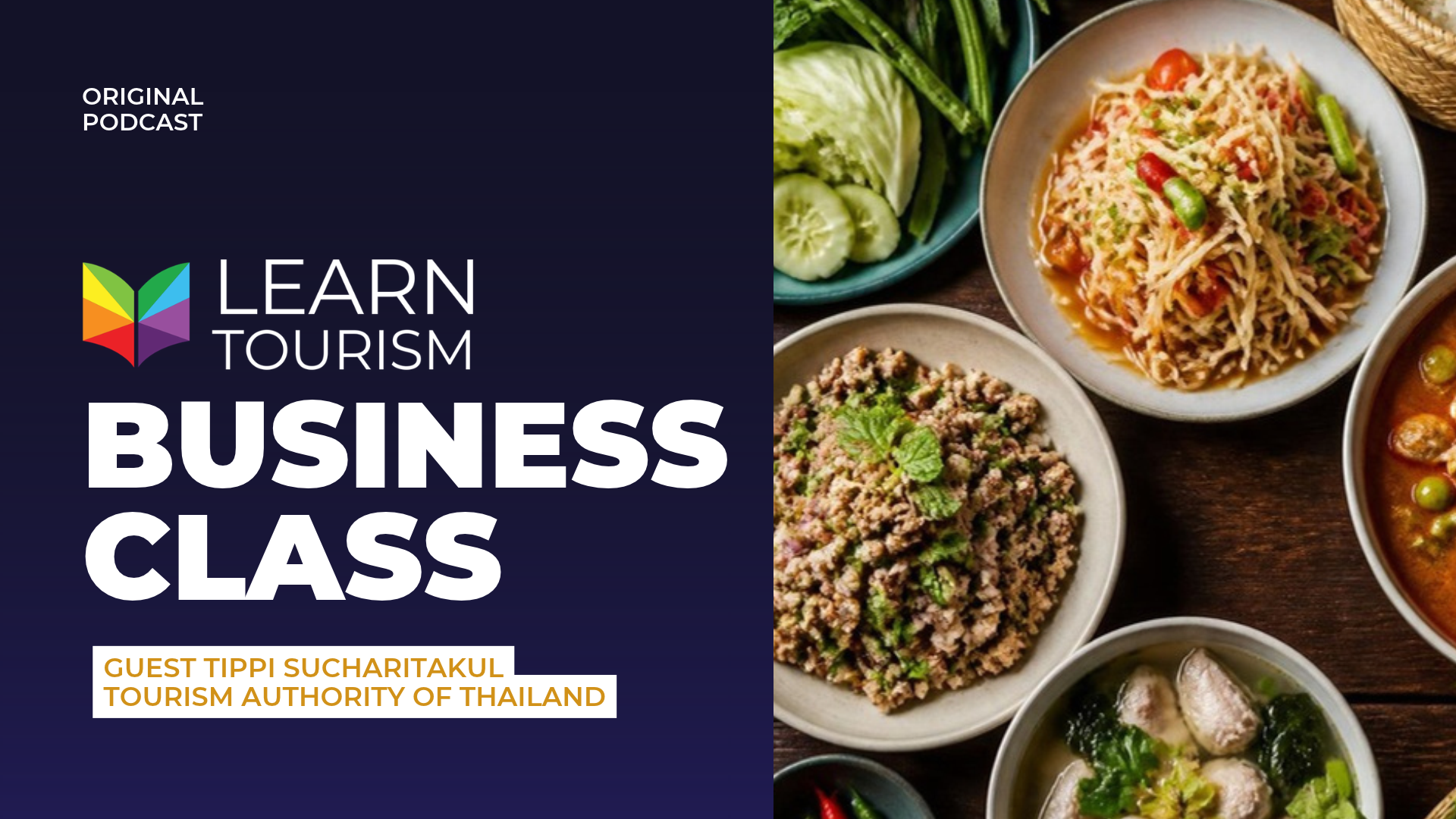
Never Just One Dish: Tippi Sucharitakul of the Tourism Authority of Thailand on Hospitality, Regions, and Learning Through Travel
Business Class by Learn Tourism | Episode with Tippi Sucharitakul, Marketing Manager, Tourism Authority of Thailand (Los Angeles office)
Order a Thai meal the way Tippi Sucharitakul would, and you won't order just one dish.
"Thai cuisine is based on the theory of five elements," she explained. "This is hot, this is cold, this is light, this is heavy. And we have to eat it as a meal, different things, so that meal would be balanced. When you have really spicy food, you have something that is really bland to balance it." Her conclusion: "If you know Thai cuisine, you won't choose to eat only one dish, because it's designed to have a balanced meal."
That is also a pretty good description of how Tippi sees her country, and her job. Thailand is not one dish. It's beaches and mountains, temples and sky bars, papaya salad and pad Thai. And helping people understand the whole table, not just the item they already know, is what she does every day as marketing manager for the Tourism Authority of Thailand's Los Angeles office, which covers the U.S. West Coast, Texas, and Latin America.
Here are the ideas from our conversation that stayed with me.
A traveler raised on curiosity
Tippi was born in the United States and spent most of her school years in Thailand. She grew up in a diplomatic family, and when her father later moved into the airline industry, the family traveled constantly on standby tickets. "I got a chance to travel a lot compared to kids at the same age," she said. "So I see things, I try, I learn, and I feel that I'm so lucky."
That upbringing led her to a hospitality degree and a long career with Thailand's tourism board. Today she sees her background as a bridge. Being Thai and living in the U.S. means she can "know the products really well and also understand what the US travelers' mindsets are. What are they looking for?"
Reflect: Who on your team understands both your destination and your key visitor market from the inside? Are you using that perspective, or just their job title?
Bigger than the postcard
When I asked about the biggest misconception people have about Thailand, Tippi was candid. For years, the image was beaches, warm weather, and an outdated "sun, sea, and sand" reputation, sometimes worse. Over the last 10 to 20 years, she said, Thailand has positioned itself very differently, and social media has helped travelers see past the stereotype. "Once you search, once you try to learn more, then you will know."
She pointed to Bangkok as the clearest example of the range. The city has been the capital for close to 250 years, "about the same age as the US," with temples and old neighborhoods sitting near a modern financial district, Michelin-recognized restaurants, and five-star hotels. "In one city, in half a day or even in one hour," you can move between both worlds.
She also connected that cultural confidence to history. Thailand is the only country in Southeast Asia that was never colonized, which she believes helped Thais "keep and retain our culture and that tradition identity really well." As she put it, you feel it "every step you walk in," in the food and in daily life.
Her one caveat about Thailand's variety made me laugh: "The only thing that we don't have is snow."
Try this: Write down the one-line stereotype visitors most often have about your destination. Then list three experiences that quietly prove it wrong. Those three are your next content calendar.
Four regions, one table
What Tippi most wishes people knew is how different Thailand's regions are. "We are about the same size as California or Texas or France, but in different shape," she said, and that shape gives the country very different tourism resources.
- The north is mountainous, good for trekking, hiking, bird watching, and northern culture and food.
- The central plains are rice country, shaped by rivers and river traditions.
- The south is a peninsula with coastline on both sides. Because the peninsula blocks the monsoon, one side is usually calm when the other isn't. That's part of why Thailand works as a year-round destination. "If it's not the season for Phuket, maybe you should choose Samui."
- The northeast is the region she most wants to showcase. It's the oldest part of the kingdom, with prehistoric evidence, cave paintings, and dinosaur finds. It is also where dishes Thais eat every day come from, like papaya salad and larb. It's the least known, she explained, largely because there are no international flights into the region.
"I want people to know that Thailand is not this small Thailand that they know," she said. "The entire food is not just pad Thai and green curry or mango sticky rice."
Every destination has a "northeast": a place, neighborhood, or story that's rich but hard to reach, so it gets left out of the itinerary. Tippi's answer isn't to hide the logistics problem. It's to keep telling the story until people want to make the trip.
Try this: Name the most overlooked part of your destination. What's the one dish, artifact, or story from there that visitors already love without knowing where it comes from? Lead with that.
Hospitality is the brand
Tippi was clear about what makes Thailand competitive with any destination in the world: its people. "The most important part is the hospitality of the people," she said. When visitors are asked why they love Thailand and why they want to come back, she told me, "number one would be the hospitality of the Thai people, and then the second would be the cuisine."
That matters because her job is not easy. She described the U.S. as a massive, expensive market to reach, with trade shows, consumer events, advertising, and PR all costing a lot. There's no direct flight from the U.S. to Thailand, so most travelers make at least one stop. Her office leans on close relationships with airline partners headquartered in Los Angeles for promotions and fam trips. She said Thailand welcomed about 1.2 million U.S. travelers last year and is working to hold its place among the top Asian destinations for Americans as Japan, China, and India compete hard.
With all of that, the warmth of everyday Thais is still the thing marketing can't buy and competitors can't copy.
Reflect: If your visitors were surveyed tomorrow, would "the people" be their number one reason to return? What are you doing to help residents and frontline staff feel like part of the brand, not just people who work near it?
The "headmaster" of destination marketing
Tippi used the word "learn" so many times that I had to ask: does she see her job as being an educator?
"Of course," she said, laughing. Her colleagues tease her about it. "They always tease me, like, 'Oh, you are the headmaster,' because I say, 'Why don't you do this? Have you heard that?'" With travel advisors, she wants them "to understand my destinations correctly." With media and other tourism boards, "it's all learning and education all the time."
That same curiosity is how she travels. She doesn't just taste food; she wants "the philosophy behind the cuisine." She noticed that Korean meals, with a main dish and many side dishes in contrasting colors, follow a similar five-elements logic to Thai food. And she gave me a quick lesson I won't forget: in her view, the wasabi and pickled ginger with sushi aren't just garnish. Raw fish is a "cold" food, and those condiments, along with hot tea or warm sake, are there to warm the stomach and help digestion. "If you learn about the real culture, then you say, 'Oh, that is why they want you to drink hot tea.'"
That's the heart of good destination marketing. Not "here's a place," but "here's why it is the way it is."
Try this: Pick one custom, dish, or tradition in your destination that visitors experience but rarely understand. Write a two-sentence "why behind it" and train your frontline team to share it.
Sustainability you can live with
Tippi's Los Angeles office also leads Thailand's sustainability efforts in the region. They work closely with Tourism Cares so that Thailand's green tourism work gets attention here, and they've built a green travel website showcasing sustainable destinations and activities.
When I asked what she wants to learn this year, her answer was personal and practical. She wants to learn how to bring sustainable practices into her daily life, "but not that extreme," because the job still means flying and meeting people. "If I can choose, then I would choose a more sustainable air partner. But if I can't, then what is the best thing I could do during the trip?"
She thinks a lot of people in our industry feel the same. "Many people, they have a good heart to do something, but maybe, similar to me, struggling because of the job or because of the family." What would help, she said, is a place where people could learn and adapt a little: "Maybe I can't do this, but I can do this."
That's a learning design challenge as much as a sustainability one. Most of us don't need more guilt. We need small, realistic choices that fit the lives we actually lead.
Reflect: What's one sustainable habit your team could realistically adopt on its next business trip? Start there, not with the perfect plan.
A closing reflection
Tippi's whole approach comes back to that balanced Thai meal. A destination is never one dish, and a visitor who only knows the dish they ordered last time is missing most of the table. Our job, whether we're marketers, frontline staff, or community leaders, is to be a little bit of a headmaster: curious, generous, and always ready to explain the "why."
So here's my question for you: What's one part of your destination's "table" that visitors keep skipping, and what would it take to help them understand why it belongs there?
Listen to the full conversation with Tippi Sucharitakul on Business Class by Learn Tourism: [EPISODE LINK].
Business Class is a podcast by Learn Tourism, featuring conversations with destination and tourism leaders from around the industry. Learn more at learntourism.org.