
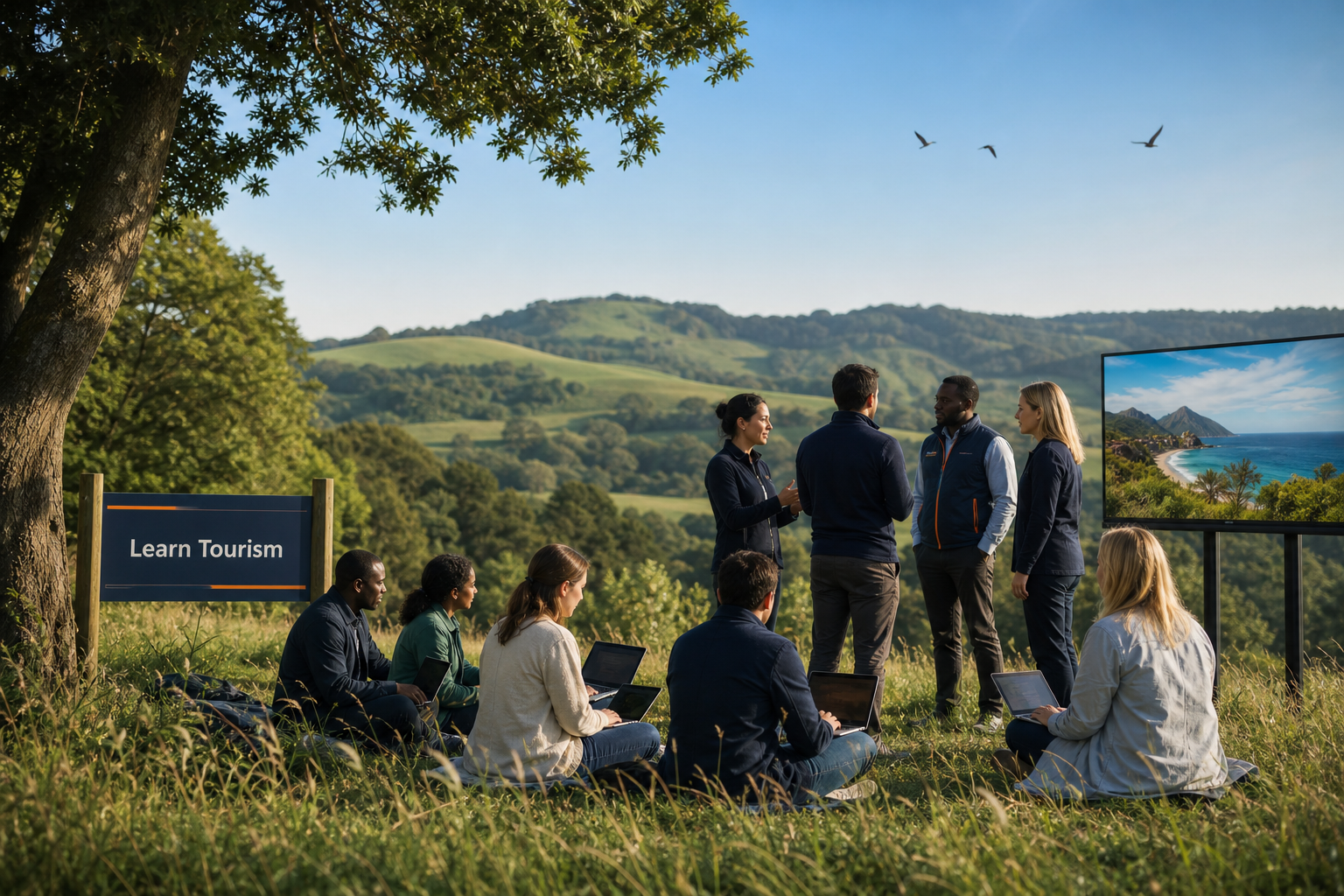
The Greenest Training Trip Is the One Nobody Has to Take
Tourism has a funny relationship with travel. We spend our careers inviting people to come see something special, and we know every one of those trips has a footprint. Most of us have made peace with that, because visiting a place is the point.
But training isn't the point. Training is how we get ready for the point.
So here's a question worth asking at your next planning meeting: how much of your destination's carbon budget is going to getting people into a room so they can learn something they could have learned just as well, or better, from where they already are?
At Learn Tourism, we think about this a lot. Here's what the research says, what we've built our own organization around, and how to make the sustainable choice without sacrificing the human connection that makes great training stick.
What does the research say about e-learning and sustainability?
The short version: when learning moves online, the biggest savings come from all the things that don't happen. No flights, no rental cars, no hotel nights, no heating and cooling a conference room for a day.
A few studies worth knowing:
Distance learning uses far less energy than campus-based learning. Researchers at the UK's Open University compared 20 courses and found that distance learning used 87% less energy and produced 85% lower CO2 emissions per student than full-time campus courses (Roy, Potter, and Yarrow, International Journal of Sustainability in Higher Education, 2008). Interestingly, the study found much smaller differences between online and print-based distance courses. In other words, the win isn't the screen. It's skipping the commute, the housing, and the building.
Virtual events can cut a gathering's footprint by 94%. A Cornell-led life cycle assessment published in Nature Communications found that moving from in-person to virtual conferencing reduced the carbon footprint by 94% and energy use by 90% (Tao et al., 2021). Even well-planned hybrid events, with more than half of attendees still in person, could cut both by about two-thirds. The biggest lever? How far people travel.
Remote work can significantly shrink a team's footprint. A Cornell and Microsoft study in PNAS found that fully remote workers can have up to a 54% lower carbon footprint than onsite workers, with hybrid workers at home two to four days a week seeing reductions of 11% to 29% (Tao et al., 2023).
A fair caveat, because we teach first and sell second: none of this means online is zero-carbon. Devices, data, and home electricity all count, and the researchers are clear that lifestyle choices shape the results. But the pattern across studies is consistent. Travel is the heavy lifter, and online learning removes most of it.
Why this matters so much for tourism training
Tourism training has a particular challenge: the people who need it most are spread out and busy.
Think about who's on a typical destination's learner list:
- Tourism ambassadors and volunteers who live all over a county or region
- Frontline hospitality staff working shifts across hotels, restaurants, and attractions
- Travel advisors who sell your destination from hundreds or thousands of miles away
- Partners, residents, and community leaders who want to learn but can't give up a full day
Bringing all of those people to one place, at one time, is expensive in dollars, time, and emissions. For travel advisor training in particular, the in-person model often means flying people to the destination to learn about the destination. Fam trips have real value, and we're not suggesting you cancel them. But the foundational knowledge (geography, product, seasonality, the stories that make your place special) can be learned online first, so in-person time is saved for the experiences only an in-person visit can deliver.
That's not just greener. It's better learning design.
Online doesn't have to mean passive
Here's where we get a little passionate. "E-learning" has a reputation problem, and some of it is earned. Too many online courses are slide decks with a quiz bolted on.
That's not what we build. Every Learn Tourism experience is designed around our T.E.A.® philosophy: Transformative, Engaging, and Accessible.
- Transformative: Learners leave able to do something new, like welcome a visitor with confidence or recommend the right experience to the right traveler.
- Engaging: Storytelling, scenarios, reflection prompts, and community discussion, not just reading and clicking "next."
- Accessible: Learners can join from a phone during a slow shift, in their own language (our platform supports 45 delivery languages), at their own pace.
That last piece is a sustainability story, too. Accessibility is social sustainability. When training is available to the part-time front-desk associate, the retired volunteer, and the single parent who can't drive two hours for a workshop, your destination's knowledge stops belonging to the few and starts belonging to the community.
And when learners finish, they earn digital certificates they can share on LinkedIn or add to a resume. No printing, no shipping, no binders gathering dust on a break-room shelf.
How Learn Tourism walks the talk
We'd feel a little silly writing this post if we didn't practice what we're preaching. So here's how sustainability shows up in how we operate, not just what we teach.
Our team works from home. Every member of the Learn Tourism team, including our interns, works remotely. No daily commutes, no office building to heat and cool. It's also how we hire for talent and fit rather than zip code.
We're committed to being carbon neutral. It's a commitment that shapes our decisions, from how we deliver training to how we gather as a team.
We plant trees through We Grow Together. This fall we launched We Grow Together, our tree-planting initiative. We plant trees to thank partners, celebrate milestones, and honor people who make our industry better. Our first project is with Scouts, and as the program grows, our priority is the national forests that need trees most.
We learn about sustainability, too. Our CEO, Steve Ekstrom, holds a certification in sustainable destination management from Cornell. We bring that thinking into our courses on destination stewardship, responsible tourism, and community engagement, because sustainability isn't a module. It's a lens.
We deliver at scale without the miles. Learn Tourism has reached more than 50,000 learners and works with more than 60 destination partners. Imagine the travel it would take to train that many people in person. Then imagine not needing to.
When in-person still wins (and how to make it count)
We love a good room full of tourism people. Some things are better face to face: team building, community listening sessions, hands-on site experiences, and the hallway conversations that spark partnerships.
The sustainable approach isn't "online only." It's online first, in person on purpose. A few practical ideas:
- Front-load the knowledge online. Use courses for the facts, frameworks, and foundations. Save in-person time for practice, discussion, and connection.
- Go local, not far. The Nature Communications study found that limiting how far attendees travel is one of the most effective ways to cut a hybrid event's footprint. Regional hubs beat one big central gathering.
- Make the in-person moment a learning experience in itself. A fam trip, a walking tour, or a volunteer planting day teaches stewardship by doing it.
- Measure what matters. Track completion, confidence, and application, not just attendance. Online platforms make this much easier.
Questions to bring to your team
Before your next training plan or budget cycle, try asking:
- Which of our current trainings require people to be in the same place, and which just default to it?
- Who on our learner list is left out because of distance, schedule, or language?
- If we cut our training travel in half, what could we do with the time and money we got back?
Frequently asked questions
Is online training better for the environment than in-person training?
Research suggests it usually is, by a wide margin. An Open University study found distance learning used 87% less energy and produced 85% lower CO2 emissions per student than campus-based courses, and a Cornell-led study found virtual conferences cut carbon footprints by 94%. Most of the savings come from avoided travel and building energy use.
What is the most sustainable way to train tourism ambassadors?
An online-first approach. Deliver core destination knowledge and hospitality skills through engaging online courses ambassadors can complete on their own schedule, then use in-person gatherings for community building, recognition, and hands-on experiences.
How can destinations make travel agent training more sustainable?
Move foundational destination education online so travel advisors can learn from wherever they sell, then reserve fam trips for advisors who are ready to experience and sell the destination. This reduces travel while improving how prepared advisors are when they do visit.
Does online learning work for frontline hospitality staff?
Yes, when it's designed well. Mobile-friendly, short, scenario-based lessons in learners' own languages fit around shift work far better than full-day workshops, and they reach part-time and seasonal staff who often miss in-person training.
What is Learn Tourism doing about sustainability?
Learn Tourism is a fully remote organization committed to being carbon neutral. Through its We Grow Together initiative, it plants trees to thank partners and honor people in the industry, prioritizing national forests with the greatest need for reforestation.
At Learn Tourism, we believe every destination is in the business of learning, and that the best training helps both people and places thrive. Ready to build an online-first program for your ambassadors, travel advisors, or frontline team? Let's talk.