
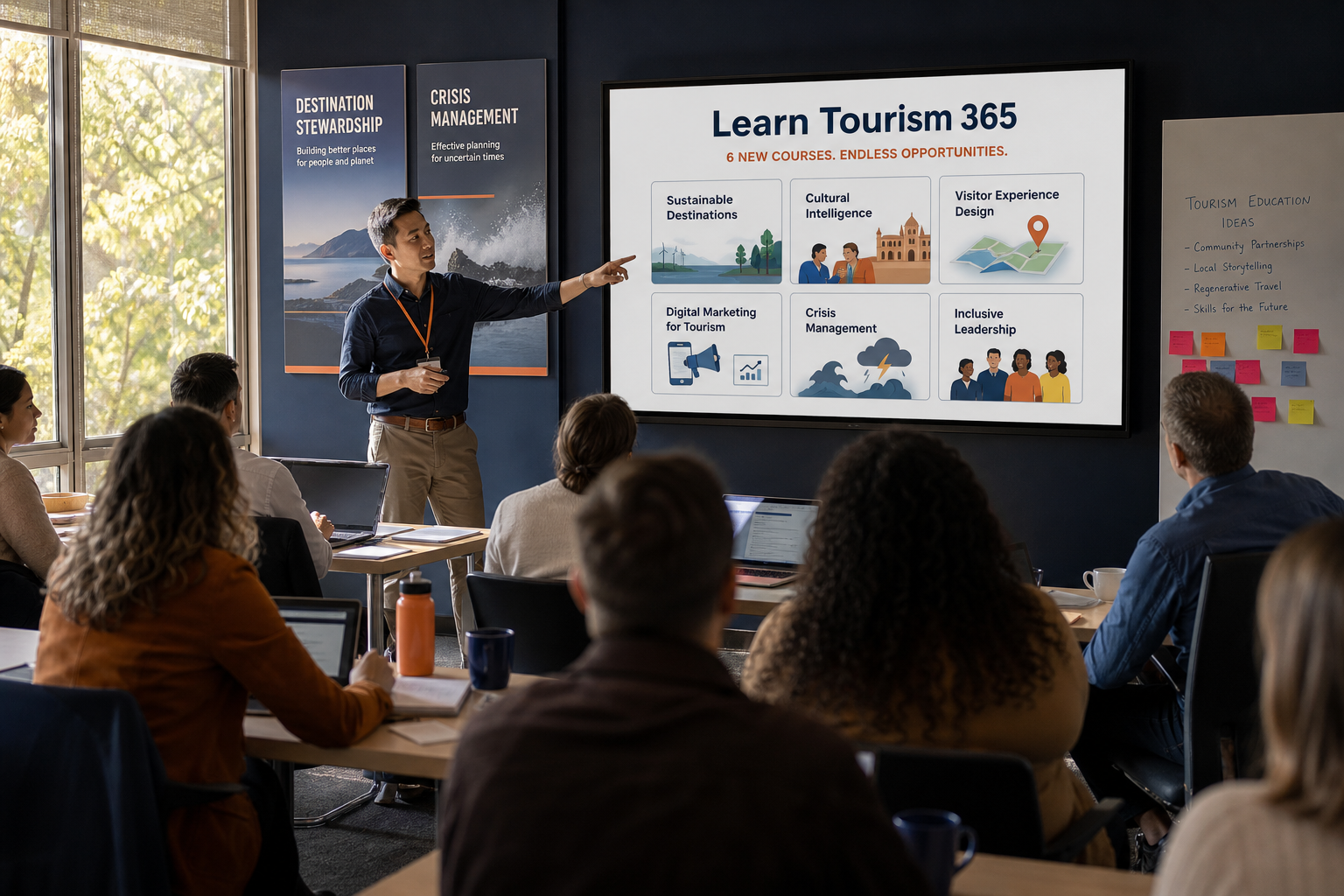
Six New Tourism Courses for Destination Teams (and the Easiest Way to Give Your Whole Team Access)
Every destination team I talk to has a version of the same list. Things we know we should be better at. Things nobody on staff was ever formally trained to do. Things that land on someone's desk because they happened to be standing closest when the problem showed up.
Who owns stewardship? What do we say in the first hour after the bridge closes? How do we use AI without embarrassing ourselves? Who's going to stand up at the budget hearing and explain why tourism matters to residents?
Those questions don't fit neatly into a generic business course. So I built six new ones that answer them directly.
They're live now, and they're included in Learn Tourism 365, our professional development library for destination organizations. Here's what's inside and why we made them.
What are the six new Learn Tourism courses?
The six new courses are Destination Stewardship 101, Crisis Ready, AI for Tourism Teams, Making the Case for Tourism, Welcoming the World, and Tourism Workforce Development. Each one is built specifically for DMOs, CVBs, tourism offices, chambers, and their partners, and each ends with a practical plan learners can put to work right away.
1. Destination Stewardship 101: Tourism That Gives Back
Tourism should leave a place better than it found it. This course opens with a story called "Two Saturdays in Harbor Point" and walks through what stewardship actually means for a DMO: the difference between marketing, management, and stewardship, the four places tourism shows up in a community, how to listen to residents, and how to spread visitors out across time, place, and pace.
It also covers teaching visitors to travel well and helping partners take small actions with big ripples.
Learners leave with: a 30-day stewardship plan.
2. Crisis Ready: Prepare, Respond, Recover
Wildfire. Flood. A closed bridge. A viral rumor. Every destination will face something, and the first hour matters most.
Crisis Ready follows a scenario called "The Night the Bridge Closed" and moves through three stages. Prepare by scanning your risks and deciding who does what. Respond with clear, caring communication to visitors, partners, and residents (learners draft their own holding statement). Recover thoughtfully, including how to run an after-action review so your team learns from it.
Learners leave with: a one-page crisis-ready starter plan.
3. AI for Tourism Teams: Practical Tools, Real Workflows
This isn't an AI hype course. It treats AI as a helpful teammate, not a shortcut, and keeps the focus on real destination work: partner newsletters, itinerary drafts that still feel local, responding to reviews, and grant research.
Learners practice a four-part prompt, learn to edit AI output like they mean it, and work through what responsible use looks like for a public-facing tourism organization.
Learners leave with: a team AI playbook.
4. Making the Case for Tourism: Residents, Elected Officials, and Community Support
Tourism is a resident's issue. This course starts with "The Budget Hearing" and helps destination teams explain what tourism does for their community, to the people who most need to hear it.
Learners map their audiences, practice listening before talking, find their local numbers, and use a simple "Number, Story, So What" structure to turn data into messages that stick. There's also practical guidance on speaking at public meetings and handling tough questions.
Learners leave with: a year-round plan for making the case.
5. Welcoming the World: International and Culturally Diverse Visitors
Every guest deserves to feel expected. Starting with "A Tale of Two Check-Ins," this course builds the everyday skills behind inclusive hospitality: plain language that crosses language barriers, tools that help, service that adapts to different expectations, and thoughtful attention to food, faith, and everyday needs.
It also tackles misunderstandings and bias with grace, and how to share local and Indigenous cultures respectfully.
Learners leave with: a welcome toolkit for their team.
6. Tourism Workforce Development: Recruit, Onboard, and Keep Great Frontline Teams
Great visitor experiences start with great people. "A Tale of Two Summers" kicks off a course about recruiting beyond the usual applicants, writing job posts people actually want to answer, and treating a new hire's first day like a guest experience.
My favorite lesson title in the whole batch lives here: "Teach the Destination, Not Just the Job." The course also covers coaching in the flow of the shift and building paths, not just positions.
Learners leave with: a 90-day tourism workforce plan, plus a downloadable worksheet.
How were these courses designed?
Every course follows Learn Tourism's T.E.A.® approach: Transformative, Engaging, and Accessible. We don't create courses, we create learning experiences, so each one follows the same rhythm:
- It starts with a story. Each course opens with a realistic destination scenario so learners see the problem before they're handed the solution.
- It asks where you're starting. A short self-assessment at the beginning, and again at the end, helps learners notice their own growth.
- It checks understanding with scenarios. Checkpoints ask "what would you do?" instead of "what did slide 12 say?"
- It ends with something you'll use. A plan, playbook, or toolkit built around the learner's own destination.
They're self-paced and built in short lessons, so a visitor center coordinator can finish one between shifts and a VP can work through one on a flight.
What is Learn Tourism 365?
Learn Tourism 365 is a professional development library that adds 100+ ready-to-use courses to a destination's own branded Learn Tourism course catalog. It's an upgrade to a Learn Tourism LMS subscription, so your team, partners, and community learn inside the same platform that already carries your destination's name and look.
The library mixes tourism-specific courses (like the six above) with practical business skills destination teams use every day: customer service, conflict resolution, presentation skills, change management, team building, social media marketing, and more.
Why not just use a general course platform?
General course libraries have their place. But they're built for everyone, which means they're rarely built for you.
A course on public speaking won't prepare someone for a county commission meeting about the bed tax. A generic customer service module won't mention that your visitors are arriving on international flights. And a stand-alone platform lives outside your branded catalog, so it's one more login and one more place your team's progress disappears.
Learn Tourism 365 is different in three ways:
- It's written for destinations. The scenarios, examples, and plans assume your learner works at or alongside a DMO.
- It lives in your catalog. Courses appear in your branded learning environment, next to your ambassador program and partner training.
- It grows. These six are the newest additions, not the last.
Who should take these courses?
Start with your own staff, then think wider. These courses work well for:
- DMO and CVB teams building skills in stewardship, advocacy, crisis communication, and AI
- Visitor center staff and volunteers who meet international and first-time visitors every day
- Hospitality and attraction partners who want to recruit and keep better frontline teams
- Board members and community leaders who need to understand and explain tourism's value
A simple way to begin: pick one course, enroll a small cross-functional group, and schedule a 30-minute conversation once everyone finishes. The discussion is often where the learning really sticks.
Frequently asked questions
What tourism courses are included in Learn Tourism 365?
Learn Tourism 365 includes 100+ courses covering tourism-specific topics and practical business skills. The newest additions are Destination Stewardship 101, Crisis Ready, AI for Tourism Teams, Making the Case for Tourism, Welcoming the World, and Tourism Workforce Development.
Is Learn Tourism 365 a separate platform?
No. Learn Tourism 365 is an upgrade to a Learn Tourism LMS subscription. The courses appear inside your destination's own branded course catalog.
Who are these courses designed for?
DMO, CVB, tourism office, and chamber staff, plus the partners, volunteers, and community leaders who shape the visitor experience.
Are the courses self-paced?
Yes. Each course is self-paced and built in short lessons, with scenario-based checkpoints and a practical plan or toolkit at the end.
Do the courses cover destination stewardship and sustainable tourism?
Yes. Destination Stewardship 101 focuses on resident listening, visitor dispersal, responsible visitor behavior, and partner action, and stewardship themes also run through Making the Case for Tourism and Welcoming the World.
Can learners use AI responsibly after taking AI for Tourism Teams?
That's the goal. The course practices real workflows like partner newsletters, itineraries, review responses, and grant research, then covers how to check, edit, and use AI output responsibly.
Learn Tourism helps destinations create learning experiences that are Transformative, Engaging, and Accessible for staff, partners, and entire communities. If you'd like to see these six courses in action or add Learn Tourism 365 to your catalog, let's talk.